
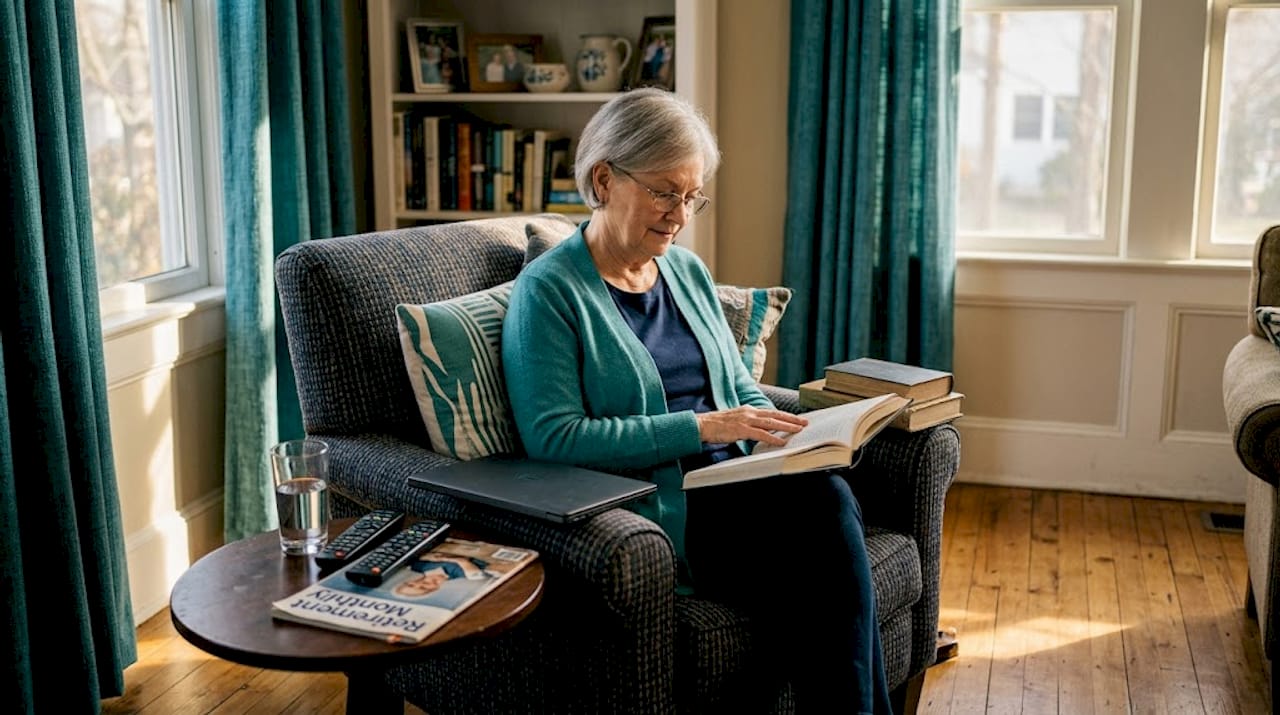
Discover why isolation affects solo agers and learn vital strategies to enhance well-being and combat loneliness effectively.
Agingsolo
Aging Solo Community
Living alone does not inherently lead to loneliness, but solo agers face unique risks from social isolation and emotional loneliness. Proactive planning, meaningful relationships, and structured social touchpoints are essential to safeguard health and independence as support systems diminish over time. Recognizing the distinction between social isolation and loneliness enables targeted actions that promote well-being and resilience.
Living alone doesn't automatically mean feeling lonely. Many solo agers intentionally built independent lives. Some never married. Others are widowed, divorced, child-free, or geographically distant from family. The challenge is not independence itself. The challenge is what happens slowly over time when routines shrink, social circles thin out, and fewer people naturally notice when something changes.
Understanding why isolation affects solo agers so deeply, and differently than it does others, is the first step toward protecting your well-being. 1 in 5 adults over 50 live alone, and that number climbs to 1 in 2 for those 75 and older. Without a built-in support system, the risks of both social isolation and emotional loneliness can quietly compound over time. This article breaks down what's really happening, why it matters, and what you can actually do about it.
| Point | Details |
|---|---|
| Isolation and loneliness differ | Social isolation is objective lack of contact; loneliness is a feeling. Both carry independent health risks. |
| Physical health takes a real hit | Prolonged isolation links to cardiovascular disease, cognitive decline, and weakened immune function. |
| Eating alone carries hidden risk | Eating alone accounts for a significant share of depressive symptoms, especially among older men living solo. |
| Social networks shrink gradually | Retirement and driving cessation quietly reduce contact. Intentional weekly touchpoints are a reliable counter. |
| Proactive planning protects you | Designating a healthcare advocate and building reciprocal relationships before a crisis matters more than most people realize. |
There's an important distinction that most general aging articles skip over. Social isolation and loneliness are not the same thing, and treating them as interchangeable is a mistake that leads to the wrong solutions.
Objective. It means you have limited contact with other people. Few calls, no regular visitors, no community ties.
Subjective. You can be surrounded by people and still feel profoundly alone. You can also live by yourself and feel genuinely content.
Why does this distinction matter for you as a solo ager? Because both conditions independently increase health risks, and you may be vulnerable to either or both. Without a spouse, a partner, or nearby adult children, the structural supports that typically buffer against isolation are simply not there. A spouse notices when you're quieter than usual. Adult children call when they haven't heard from you in a week. When those built-in check-ins don't exist, the warning signals go unnoticed, including by you.
Here's what that vulnerability looks like in practice:
Pro Tip: Use a simple weekly check-in with yourself: "Did I have at least one meaningful conversation this week?" If the answer is consistently no, that's worth paying attention to.
Different problems require different responses. Increasing social isolation calls for more contact and structure — starting with a support circle starter checklist can help you identify where you need more connection. Emotional loneliness often calls for deeper, more meaningful connections rather than simply more of them. Knowing which one you're dealing with helps you choose the right path forward, and a solo readiness checklist can help you assess where you stand across both dimensions.
This isn't about mood alone. Prolonged isolation is directly linked to higher rates of cardiovascular disease, cognitive decline, and dementia, as well as altered immune function from chronic stress. Those are not minor side effects. They're the kind of outcomes that quietly erode your independence over time.
"Social isolation in older adults is not merely a social concern. It is a significant public health risk with measurable consequences for physical and cognitive health."
The mechanism is stress. When you're chronically isolated, your body stays in a low-grade stress state. Cortisol, the primary stress hormone, remains elevated. Over months and years, that sustained elevation weakens the immune system, raises blood pressure, and accelerates the kind of inflammation that damages blood vessels and brain tissue.
| Health risk | Connection to isolation |
|---|---|
| Cardiovascular disease | Chronic stress raises blood pressure and promotes arterial inflammation |
| Cognitive decline | Reduced social stimulation accelerates memory loss and dementia risk |
| Immune impairment | Elevated cortisol suppresses immune response over time |
| Depression | Eating alone accounts for 38.5% of variance in depressive symptoms in solo households |
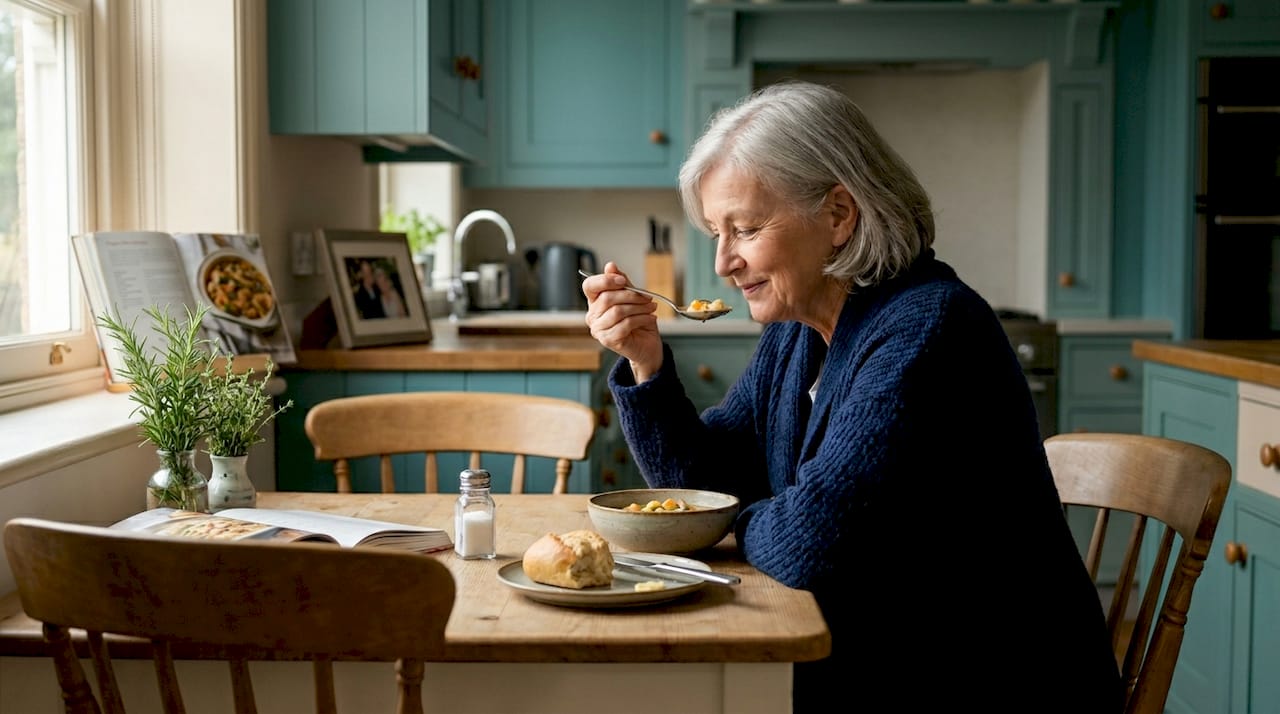
Eating alone is one of the most underappreciated contributors to depression in older adults. And it's especially significant for men. When meals are solitary and unstructured, they become shorter, lower quality, and easier to skip. The act of eating together, even occasionally, carries social and psychological weight that eating a solo meal in front of the television simply does not replicate.
Meals often anchor social life more than people realize. They provide rhythm to the day, a reason to prepare something, and an occasion to connect. When every meal becomes purely functional — fuel consumed alone — social isolation in older adults can quietly deepen without anyone noticing. Something as simple as scheduling a weekly shared meal, even virtually, can interrupt that pattern in a way that matters.
Among adults in their 60s, 41% report loneliness, up from 32% in 2010. That's not a small trend. It's a shift that reflects just how much the social fabric around aging has changed.
Isolation rarely announces itself. It accumulates quietly. And for solo agers, several life transitions make that accumulation almost predictable if you're not watching for it. Friends move away. Confidence driving at night fades. Social events become harder to navigate after hearing loss. You become "out of practice" socially. Retirement removes the built-in rhythm of human interaction that once felt automatic.
These shifts don't feel like crises in the moment. A missed coffee here, a skipped gathering there. But together, they form a slow erosion of the daily social fabric that keeps loneliness in solo agers from taking hold. Here are the transitions that most commonly set this cycle in motion.
Removes the daily structure and incidental social contact that work provides. You don't realize how much of your social life was happening at work until it's gone.
One of the biggest and least-discussed contributors to isolation. When you can no longer drive, the spontaneous trips to the store, the library, and the coffee shop disappear. Confidence often fades gradually — first at night, then on highways, then altogether. Losing driving access quietly removes dozens of low-level social interactions every week. Planning transportation alternatives before driving fully stops makes the transition far less isolating.
Happen naturally as friends move, become ill, or die. Without a partner helping to maintain those connections, the circle can narrow faster than expected.
The quiet behavioral shift where cooking for one starts to feel like too much effort. Meals become simpler, less regular, and increasingly solitary. This gradual nutritional decline is directly linked to worsening mood and mental health.
There's also a subtler trap worth naming. Enjoying solitude is healthy. Preferring your own company sometimes is normal and actually protective. But retraction without social support can tip into something more harmful, and the line between the two can be hard to see from the inside.
The fix isn't complicated, but it does need to be intentional. Weekly social touchpoints and mutual support relationships, where you and another person genuinely check in on each other, are among the most effective ways to keep isolation from quietly expanding.
Isolation rarely announces itself with a single dramatic moment. Instead, it shows up in subtle shifts that are easy to rationalize or overlook entirely. Solo agers who have spent decades managing their own lives may be especially skilled at not noticing these quiet signals.
Days passing without a single meaningful conversation
Delaying errands to avoid casual interaction
Eating every meal alone, without variation or ritual
Feeling mentally "foggy" after long stretches alone
Losing motivation to leave home, even for things you once enjoyed
No one who would notice if your routines suddenly changed
Any single one of these signs might mean little on its own. But when several are present together, they often point to a pattern worth addressing — the kind of slow withdrawal that makes aging alone without a support system riskier than it needs to be. A hidden loneliness checklist can help you spot patterns you may have normalized.
Pro Tip: Anchor your social touchpoints to something you already do. A standing Tuesday lunch, a weekly phone call on Sunday mornings, or a regular class creates structure without pressure.
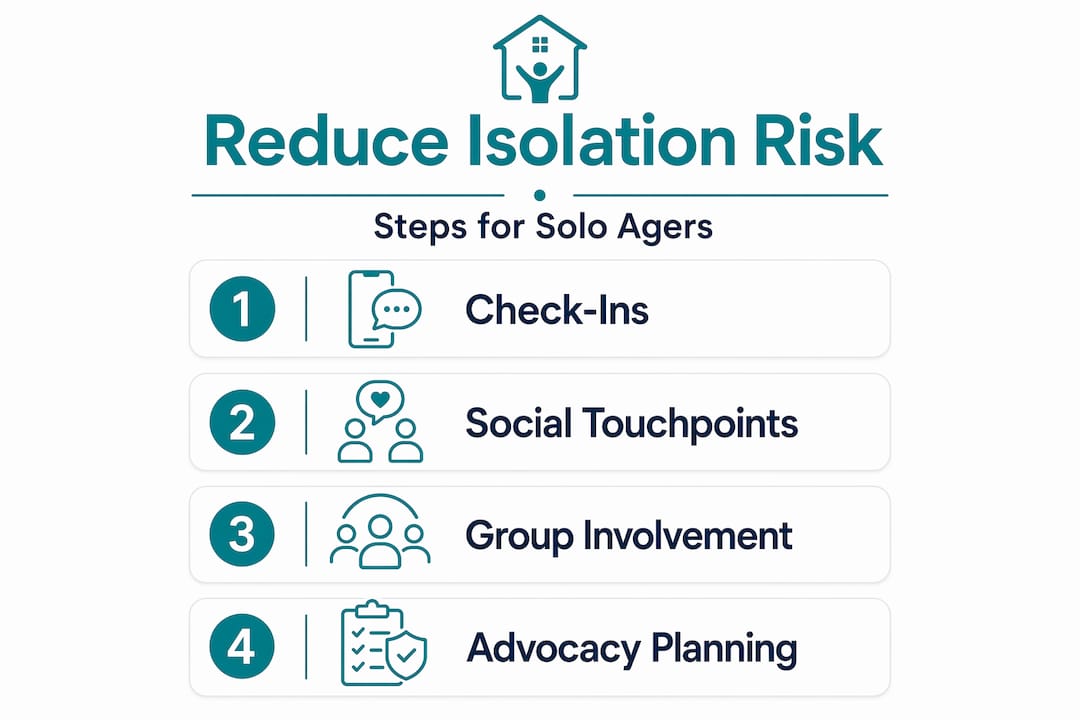
Knowing the risks is one thing. Building a steady, realistic response to them is another. Here's what actually works.
Meaningful reciprocal connections are far more protective than a long list of acquaintances. You want people who notice if they haven't heard from you. You want relationships where you're both giving and receiving. That mutual accountability is what makes a connection genuinely protective. Building what some call a chosen village takes time, so start before you feel you urgently need it.
Solo agers who don't have a healthcare proxy on record risk becoming "unrepresented" in medical settings, where decisions fall to ethics committees who don't know your values or wishes. This is one of the most concrete steps you can take to protect your autonomy. A life care plan that includes your healthcare proxy, your preferences, and your emergency contacts is a foundation worth building early. Pair it with an emergency planning checklist so critical information is accessible when it matters most.
Generic senior centers are fine, but a group where people share your specific situation tends to go deeper. The conversations are more honest. The connections are more relevant. And the practical support — people who understand what it means to age without a built-in safety net — is genuinely different.
Here's a comparison of approaches to managing social isolation:
| Approach | What it addresses | Limitation |
|---|---|---|
| Increasing social contacts | Objective isolation | Doesn't resolve emotional loneliness |
| Therapy or counseling | Emotional loneliness, depression | Doesn't build structural social support |
| Community groups | Both isolation and belonging | Requires consistency and follow-through |
| Reciprocal check-in relationships | Objective isolation and accountability | Needs intentional setup and maintenance |
Set a rhythm around meals. Cook a real meal at least a few times a week. Eat with others when you can, even virtually. The goal isn't perfection. It's making meals a small ritual rather than an afterthought, because that ritual carries more mental health weight than most people expect.
Psychological flexibility and strong social support together form some of the strongest protective factors available to solo agers. The two reinforce each other. When you stay connected, you stay more adaptable. And when you stay adaptable, you're better at staying connected even as circumstances shift.
One of the most persistent misconceptions about solo aging is that isolation is a personality problem. That if you're a self-sufficient, independent person who chose this path, isolation simply won't happen to you.
That's not how it works. Isolation is a structural and behavioral issue, not a character flaw. It grows when the external scaffolding of social contact, work, driving, partnership, gradually disappears. The most capable, self-aware people have been blindsided by it. This is why aging independently requires more than independence — it requires ongoing attention to the systems that keep isolation at bay, from home safety to technology that maintains social connection.
What I've also learned is that the "I'll get to it" approach to healthcare advocacy is genuinely dangerous. Many solo agers delay designating a Power of Attorney for Healthcare until they're already in crisis. By then, the options narrow fast. Early planning isn't about expecting the worst. It's about keeping control when things don't go as planned.
The other thing I'd push back on is the idea that more social activity automatically means better well-being. Quality beats quantity, consistently. A standing weekly call with one person who truly knows you is worth more than a packed social calendar filled with surface-level interactions. If you're building your social life as a solo ager, build it around depth. That's where aging independently becomes genuinely sustainable.
Solo aging isn't a problem to be solved. It's a reality to be planned for with honesty and intention. And when you plan well, the quiet doesn't have to feel heavy.
— Mike
Healthy solo aging is not about avoiding independence. It is about building intentional layers of support, connection, and visibility around the life you already value. Strong support circles for older adults rarely appear automatically later in life. They are built gradually, relationship by relationship, long before a crisis arrives.
Isolation and loneliness are real challenges for solo agers, but they're also ones you can actively address with the right resources and community around you. Agingsolo is built specifically for people in your situation: adults growing older without a traditional support network who want a practical, realistic plan for what comes next.
Whether you're looking to build your support circle from the ground up or explore the real benefits of connecting with others who understand solo aging firsthand, Agingsolo has resources designed to help. The Aging Solo community groups are a good place to start.
These aren't generic gatherings. They're spaces where people at similar life stages share real strategies, real concerns, and real accountability. You'll find tools, guides, and a community that takes solo aging seriously, without sugarcoating the challenges or overlooking what's genuinely possible.
Aging Solo
Aging Solo
Aging Solo
Aging Solo