

For solo agers, planning ahead is not pessimistic. It is one of the most practical and compassionate things you can do for yourself.
A life care plan gives you structure, clarity, and real control over what comes next. Whether you are managing a chronic condition, thinking about mobility changes, or simply want to feel prepared, this guide will walk you through what a life care plan is, how it works, and why it may be one of the most empowering tools available to solo agers today.
Many solo agers do not have adult children nearby, a spouse to step in during a crisis, or family members available to coordinate care decisions. That does not mean aging alone has to mean aging unsupported. A thoughtful life care plan creates structure before stressful situations happen.
Support does not always come from traditional family structures. Many solo agers build a trusted circle of friends, neighbors, professionals, faith communities, or advocates who become part of their chosen village over time. A life care plan helps you identify and formalize these connections so your chosen village knows how to support you when needed.
Let's start with the basics, because this term gets misunderstood more often than not.
According to PM&R KnowledgeNow, "a life care plan is a detailed, structured document that projects an individual's current and future medical and support needs (and related costs) over the person's expected lifetime." In plain terms, it is a written roadmap that looks ahead at what kind of care you may need and what it will likely cost.
Many people assume life care plans are only for people who have been in serious accidents or who are dealing with catastrophic illness. That is a common misconception. A life care plan can be useful for anyone who wants to think clearly about their future needs, especially when there is no spouse, partner, or nearby family to help fill in the gaps.
For solo agers, this kind of document is not just useful. It can be genuinely life-changing. Here's why:
If you have already started thinking about emergency health planning, a life care plan builds on that foundation in a much more structured way. And if you are looking for ways to building a stronger support circle, a life care plan works hand-in-hand with those connection-building efforts.
"A life care plan is not about expecting the worst. It is about giving yourself the best possible chance to stay in control of your own life."
Having defined what a life care plan is, let's break down the process of how one is actually developed.
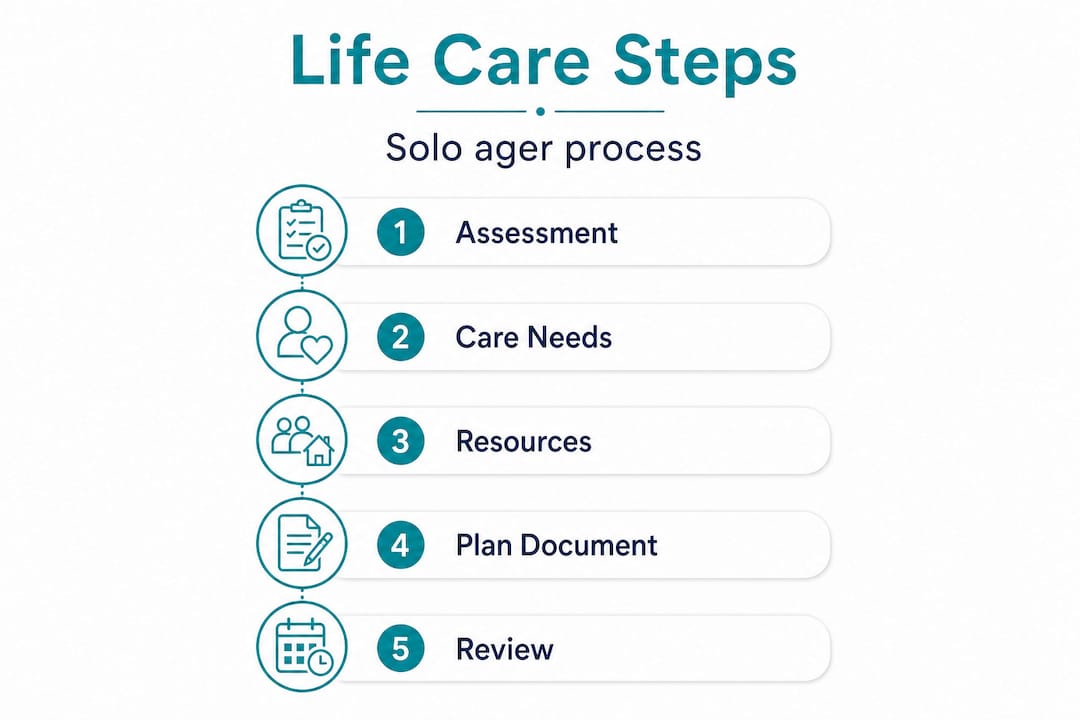
Life care plans are generally built from a methodical process: thorough assessment and data analysis, followed by assembling an organized set of care recommendations with associated cost projections. That might sound technical, but the steps themselves are straightforward.
Here's how the process typically unfolds:
A life care planner, often a nurse, rehabilitation specialist, or certified care manager, gathers detailed information about your current health, functional abilities, and living situation. For solo agers, this also includes your social support structure, or the absence of one.
Medical records, physician input, therapy evaluations, and any existing care plans are collected and reviewed. The goal is to get a complete, honest picture of where you are right now.
The planner identifies what types of care and support you are likely to need over time. This includes medical care, physical or occupational therapy, daily living assistance, and home modifications.
Each identified need is matched with a realistic cost estimate based on current market rates and expected frequency of use. These projections are updated periodically as your situation changes.
All of this information is compiled into a clear, organized document that can be shared with healthcare providers, legal advisors, or anyone involved in your care.
A good life care plan is not a one-time document. It should be reviewed regularly, especially after major health changes or life transitions.
You can access care coordination resources to help you think through who might be involved in supporting your plan. And if you are looking for a broader starting point, the support services guide is a great place to explore what is available.
Pro Tip:
Start collecting your medical records, medication lists, and any existing care documents now. Having this information ready makes the planning process much smoother and less overwhelming when you are ready to move forward.
Starting a life care plan can feel overwhelming, but you can begin with small, actionable steps today:
Ensure your medical wishes are legally documented.
Identify someone trustworthy who can be reached if needed.
Keep essential information accessible to trusted people.
Identify hazards and plan modifications for aging safely at home.
Connect with neighbors or trusted local professionals.
Have honest conversations about your wishes with your chosen circle.
Document your preferences, contacts, and important information in one place.
Now that you know the steps, let's see what actually goes into a life care plan.
A thorough life care plan covers a wide range of needs. The methodical process of assessment and data analysis ensures that each component reflects your actual situation, not a generic template.

Here's a breakdown of the typical components:
| Component | What it covers | Why it matters for solo agers |
|---|---|---|
| Medical care | Physician visits, specialist appointments, medications | Ensures continuity of care without relying on family to track it |
| Therapy services | Physical, occupational, speech therapy | Supports recovery and maintains independence |
| Assistive devices | Wheelchairs, walkers, hearing aids, medical alert systems | Reduces fall risk and supports daily function |
| Home modifications | Ramps, grab bars, widened doorways, stair lifts | Allows you to age in place safely |
| Personal care support | Help with bathing, dressing, meal preparation | Addresses daily needs when self-care becomes difficult |
| Transportation | Medical transport, ride services | Critical when driving is no longer possible |
| Mental health support | Counseling, social programs, community engagement | Addresses isolation and emotional wellbeing |
| Projected costs | Estimated expenses for each category over time | Supports financial planning and insurance decisions |
When thinking about your own plan, consider these areas:
Exploring assistive technology tools can help you identify devices that support independence at home. And thinking about daily support networks is equally important when you are planning without a built-in family safety net.
Understanding the elements, let's explore who most benefits from having a life care plan and what real-life situations look like.
The short answer is: anyone aging without a built-in support system benefits from having a life care plan. But the need becomes especially clear in specific situations.
In the healthcare and litigation context, "life care plans are typically prepared to quantify future care requirements in a way that can be used for legal or insurance decision-making." This means your plan can carry real weight in legal, financial, and medical settings.
| Situation | With traditional support | As a solo ager |
|---|---|---|
| Health crisis | Care coordinators step in | Plan document guides providers |
| Daily living decline | Support networks step in informally | Paid support or community services fill the gap |
| Financial decisions | Advisors help manage | Plan provides a clear financial roadmap |
| Legal or insurance needs | Representatives advocate | Written plan serves as documented evidence |
| Housing transitions | Support network helps research | Plan outlines housing needs and costs in advance |
A solo ager who survives a stroke needs a clear plan for rehabilitation, home modifications, and ongoing support. Without a coordinated support plan in place, a documented plan ensures providers know exactly what is needed.
Early-stage cognitive changes are the right time to create a life care plan. Once documented, the plan can guide future decisions even when you are no longer able to advocate for yourself.
Gradual changes in mobility, like arthritis or balance issues, can be planned for proactively. A life care plan identifies assistive devices and home modifications before a fall or injury forces the issue.
Managing diabetes, heart disease, or COPD over the long term involves ongoing costs and care needs. A plan helps you track and prepare for these expenses systematically.
"Planning is not pessimism. It is one of the most self-respecting things you can do for yourself."
For more on how to approach these situations, the health and legal planning section of Aging Solo covers the intersection of medical and legal preparedness in practical detail.
Here's a perspective that solo agers rarely hear, and it comes from years of working alongside people navigating aging without a traditional support system.
Most people think of life care plans as something that happens to you after a crisis. A car accident. A serious diagnosis. A legal dispute. And yes, a life care plan does project an individual's current and future medical and support needs over a lifetime. But waiting for a crisis to create one is like waiting for a fire to buy a smoke detector.
The real value of a life care plan for solo agers is not crisis management. It is agency.
When you have a documented plan, you are not at the mercy of whatever decisions get made around you in a moment of stress or emergency. You have already made the decisions. They are written down. They are clear.
There is also something deeply calming about it. Many solo agers describe a kind of background anxiety, a low hum of "what if" that never quite goes away. What if I fall? What if my health changes? What if no one knows what I want? A life care plan quiets that hum. Not because it removes uncertainty, but because it shows you that you have already thought it through.
The most common pitfall we see is avoidance. People wait for a family member to bring it up, or they assume they will get to it later. But later has a way of becoming never. And for solo agers, there is no one else who is going to initiate this conversation on your behalf. That is not a criticism. It is simply the reality of living independently.
The other pitfall is assuming the plan is only useful in extreme situations. It is not. A life care plan helps you make better everyday decisions about housing, finances, health care, and support. It is a tool for control, not just for crisis or litigation.
If you are ready to take a more intentional approach, the resources for proactive planning on Aging Solo are a strong starting point.
A life care plan is not about expecting the worst. It is about protecting your independence, reducing uncertainty, and making sure your voice remains central in future decisions. Solo aging works best when it is supported by preparation, connection, and clarity.

Aging Solo exists to help you turn insight into action. Whether you are just beginning to think about your future or you are ready to build a detailed plan, the tools and guides here are designed with your situation in mind. Start with the solo aging guide to get grounded in the fundamentals, then explore the planning philosophy that shapes everything we do. When you are ready to dig into specific resources, the solo aging resources library has practical tools to support every stage of your planning journey. You do not have to figure this out alone.
Aging Solo Today offers practical guidance, planning tools, and encouragement for adults navigating aging independently. Explore resources designed to help you stay prepared, connected, and confident about the future.