
Master the solo ager financial planning basics for a secure retirement. Learn key strategies for building your safety net today!

Most retirement advice quietly assumes there will be someone sitting across the kitchen table from you. Someone to share expenses, help make difficult decisions, or step in when life becomes complicated.
If you're aging solo, that assumption doesn't fit your life.
That doesn't mean your future is less secure. It simply means your financial plan has to do a little more work. With thoughtful preparation, you can build a retirement that is financially stable, personally meaningful, and entirely your own.
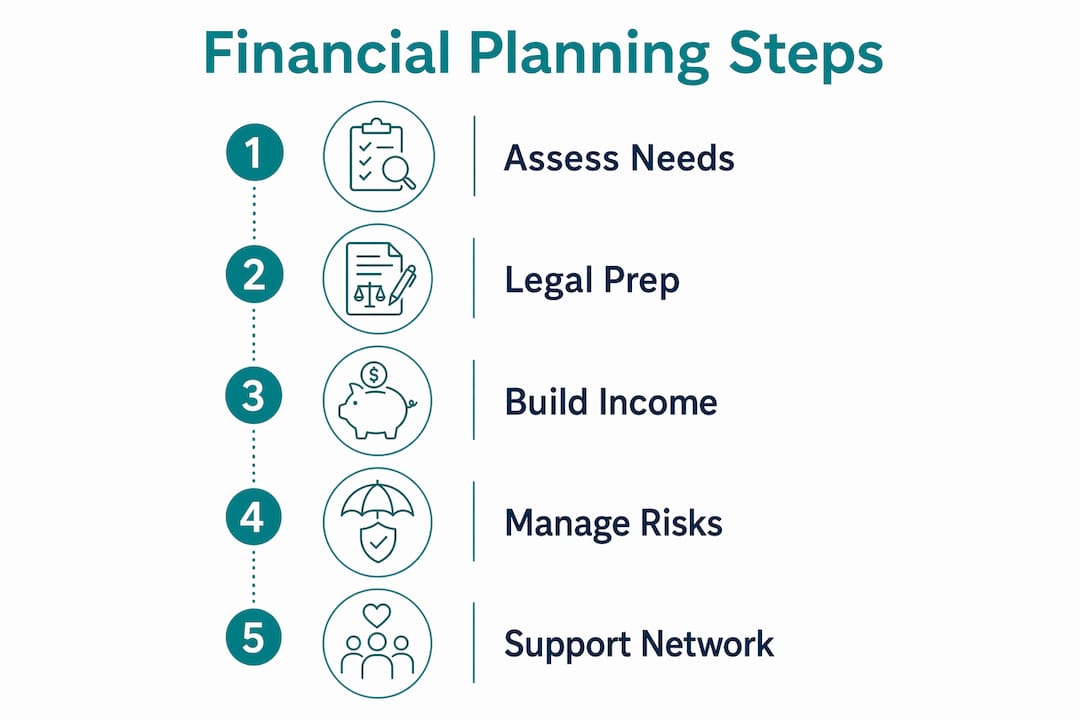
Financial experts recommend keeping 12–18 months of living expenses in an emergency fund, double the 3–6 months typically advised for couples. That single shift captures the spirit of planning as someone aging on your own. You are your own safety net, so you build it stronger.
Start with four priorities. Build an emergency fund that's larger than most retirement advice recommends. Make sure every legal document is complete — a will, a durable financial power of attorney, and a healthcare proxy. Set up automatic contributions so saving happens before you can talk yourself out of it. Review beneficiary designations every year — a forgotten ex-spouse on a 401(k) is a real and surprisingly common problem. And begin thinking about long-term care long before you believe you'll need it. None of these decisions require a crisis. They simply require getting started.
Money cannot prevent every difficult season. What it often does is buy you something just as valuable — time. Time to make thoughtful decisions instead of desperate ones. Time to choose rather than react. For those of us aging on our own, that time can become one of the most valuable assets we hold.
These steps don't require a financial crisis to trigger them. They just require a decision to start.
The pre-retirement years are your best opportunity to get ahead of the challenges that come later. You have income, time, and flexibility. Use all three.
Push your emergency savings further. The 12–18 month buffer is the target, but even moving from three months to six months is progress worth celebrating. Max out retirement accounts and use every dollar of catch-up contributions if you're 50 or older — the IRS allows additional contributions to 401(k) and IRA accounts each year. If you have a high-deductible health plan, open and fund a Health Savings Account. It's one of the most tax-efficient tools available for future healthcare expenses.
Pay down debt deliberately. Carrying a mortgage or credit card balances into retirement on a single income creates real pressure, and reducing debt now lowers your monthly needs later. And start picturing your retirement life concretely. Where do you want to live? What will your days look like? Sara Zeff Geber, author of Essential Retirement Planning for Solo Agers, puts it plainly: you need a plan for what you are retiring to, not just what you are retiring from.
Pro Tip
If your employer offers long-term care insurance as a benefit, enroll now. A recent survey by the Employee Benefit Research Institute found that a portion of benefits-eligible workers have access to long-term care coverage, but enrollment rates remain low.
The first years of retirement often feel lighter than expected. Income from work stops, but so does the stress of the job. This is also when financial habits matter most, because the decisions you make now set the trajectory for everything that follows.
Track your actual spending, not your projected spending. Many people discover their real expenses differ from their pre-retirement estimates — adjust based on what you actually spend in the first 12 months. Delay Social Security if you can. Waiting until age 70 increases your monthly benefit by 8% for each year you delay past your full retirement age. For anyone aging on their own, that guaranteed, inflation-adjusted income is worth more than the same amount sitting in a market-exposed portfolio.
Automate your finances. Automating savings and bill payments reduces the daily cognitive load and protects you if your health ever makes managing money harder. Preserve your portfolio by avoiding large withdrawals in the early years — sequence-of-returns risk, meaning a market downturn early in retirement, can permanently damage a portfolio that has no second income to offset it.
And invest in your social life as deliberately as your savings. Isolation is a real financial risk. Those who stay connected tend to make better decisions, catch problems earlier, and need less paid support later.
Somewhere in your mid-70s, the financial picture starts to shift. Spending on travel and hobbies may ease, but healthcare and support costs tend to rise. This is the phase where priorities need rebalancing.
Review your long-term care insurance. If you purchased a policy earlier, confirm the benefit amounts still reflect current care costs. If you don't have coverage, explore hybrid life insurance products that include long-term care riders. Adjust your withdrawal rate carefully — without a spousal income buffer, financial planners generally recommend a more conservative withdrawal rate than the widely cited 4% rule. Work with a Certified Financial Planner (CFP®) to find the right number for your situation.
Plan your housing transition before you need it. Waiting until a health crisis forces a move is one of the most expensive mistakes you can make. The Pension Research Council notes that decision-making and logistics become significantly harder once limitations are already present.
Build your professional support team. A geriatric care manager, a daily money manager, and a trusted financial advisor are not luxuries at this stage — they are infrastructure. And invest in your health. Reducing the duration and severity of physical or cognitive decline directly reduces its financial cost. Preventive care, exercise, and social engagement all pay dividends in this phase.
Late retirement is when the plan you built earlier does its most important work. You may need more support, and the people around you may be less able to provide it informally. This is the time to make sure your legal and financial structures are solid.
Appoint a professional fiduciary. Licensed fiduciaries typically charge $100–$250 per hour but bill only when active, making them a cost-effective and legally reliable option when family isn't available. Keep income streams steady — Social Security, annuity income, or pension payments provide a predictable floor. Make sure your budget for care costs is built on top of that floor, not instead of it.
Update your legal documents every three to five years, or after any major life change — wills, powers of attorney, and advance directives don't age well when ignored. Guard against financial abuse. Those aging alone are particularly vulnerable — avoid giving informal account access to anyone, set dual-signature requirements for large withdrawals, and consider a financial monitoring service.
Consider a hybrid trustee arrangement. A corporate trustee handles asset management with institutional stability, while a professional fiduciary manages healthcare decisions with personal attention. This combination provides continuity that no single individual can guarantee.
Where you live and who you know are not soft lifestyle questions. For anyone aging on their own, they are financial decisions with real dollar consequences.

Housing choices directly affect retirement expense streams and the level of care you will need to pay for. A home that works well at 65 may require costly modifications or a full move by 80. Planning that transition early, before limitations arrive, preserves both your options and your savings. Research from the Pension Research Council shows that waiting until a health crisis forces the decision makes both the logistics and the finances significantly harder.
The best home isn't always the one you've lived in the longest. Sometimes it's the one that makes the next twenty years easier instead of harder.
Your housing options range from aging in place with modifications, to senior communities, to continuing care retirement communities (CCRCs) that offer multiple levels of care on one campus. Each carries a different cost structure and a different social environment. A CCRC, for example, typically requires a substantial entry fee but provides predictable ongoing costs and built-in community. Aging in place preserves familiarity but shifts all support costs onto you.
Social connection is woven into this decision. Residential choices that build community reduce isolation, support mental health, and often reduce the need for paid care later. Solo agers who maintain active social networks tend to catch health problems earlier and recover faster. That is not just good for wellbeing. It is good for the budget.
Pro Tip
If you plan to stay in your current home, get a professional home assessment now. Modifications like grab bars, wider doorways, and no-step entries are far cheaper to install during a renovation than as emergency retrofits.
Most legal and healthcare systems naturally assume a family member will be available when important decisions need to be made. If that isn't your situation, it's simply one more reason to prepare intentionally.
Without a designated healthcare proxy and financial power of attorney, hospitals, courts, or government agencies may make decisions on your behalf. Those decisions may not reflect your wishes at all. Court-appointed guardianship is expensive, slow, and removes your control entirely.
Your legal document set should include a last will and testament (without one, a judge decides who inherits your assets), a durable financial power of attorney giving a trusted person legal authority to manage your finances, a healthcare proxy naming the person who makes medical decisions when you cannot, and a living will or advance directive spelling out your wishes for end-of-life care so no one has to guess.
Professional fiduciaries fill the role that adult children or spouses typically play. They are licensed, legally accountable, and bound to act in your interest. The $100–$250 per hour cost is real, but they only bill when active, which keeps the total manageable.
Pro Tip
Balance institutional and personal fiduciaries. A corporate trustee at a bank provides continuity if your individual fiduciary retires or becomes unavailable. Use both, with clearly defined roles, for the most resilient arrangement.
Solo agers also face elevated risk of elder financial abuse. Practical safeguards include using a corporate trustee rather than an informal helper for asset management, setting dual-signature requirements on accounts with large balances, and designating a trusted contact at your financial institution who can flag unusual activity.
Budgeting when you're planning independently is not a one-time exercise. It's a living document that shifts as your life does.

In early retirement, your biggest budget risk is underestimating how much you will spend on experiences and health. Most solo agers spend more in the first decade of retirement than they projected. Build that reality into your plan rather than hoping your projections hold.
In middle retirement, healthcare costs tend to rise while discretionary spending falls. Choosing between traditional Medicare and Medicare Advantage is one of the most consequential financial decisions of this phase. Traditional Medicare offers broader provider access; Medicare Advantage can have lower premiums but higher out-of-pocket maximums. Understanding Medicare options for your specific health history and financial situation matters more than picking the plan with the lowest monthly cost.
In late retirement, the budget shifts again toward care. Build a separate care cost line into your budget now, even if you do not need it yet. Knowing the number reduces the shock when the time comes.
Financial planning works best when it includes the parts of life that don't show up on a spreadsheet. Purpose, connection, and physical health aren't separate from your financial plan — they are part of it.
Those who invest in their foundational health — regular exercise, preventive care, strong social ties — tend to experience shorter and less costly periods of dependency later in life. That directly reduces the financial burden of care. The American Society on Aging frames this clearly: minimizing the duration of physical or cognitive impairment also minimizes its financial cost.
Retirement also needs a reason to get up in the morning. Volunteering, part-time work, creative pursuits, and community involvement all contribute to mental health and cognitive resilience. They also reduce the quiet that can settle in when a structured workday ends. Planning for meaning is not a luxury. It's part of a complete retirement plan.
If you're aging on your own, you don't have access to spousal Social Security benefits or a second pension. That makes building a reliable income floor one of the most important tasks in your financial plan.
Social Security is the most powerful tool available. Delaying your claim to age 70 increases your monthly benefit by 8% for each year past your full retirement age. For anyone without a second household income, that guaranteed, inflation-adjusted income stream is more valuable than an equivalent amount in a market-dependent portfolio.
Beyond Social Security, consider building income from annuities (a fixed annuity converts a lump sum into guaranteed monthly payments for life), dividend-producing investments that generate regular income without selling assets, part-time work or consulting that supplements income while providing social connection, and rental income if you own property. The goal is a layered income structure where guaranteed sources cover your baseline needs and portfolio withdrawals cover the rest.
The goal isn't becoming wealthy in retirement. The goal is creating dependable income that allows you to sleep well at night.
Risk management looks different when you are the only person in your household. There is no partner to absorb a financial shock, cover expenses during a health crisis, or step in if you are temporarily unable to manage your affairs.
Long-term care insurance is one of the most discussed tools for solo agers, and for good reason. Most Americans who reach age 65 will need significant long-term care at some point, according to federal health data. For solo agers without family caregivers, that care will largely be paid. Long-term care insurance policies typically pay benefits after an elimination period and when you cannot perform multiple activities of daily living. Premiums vary widely based on age, health, and benefit levels, so buying earlier generally means lower costs.
Hybrid life insurance products that combine a death benefit with a long-term care rider offer an alternative for those who cannot qualify for or afford standalone long-term care coverage. They are not perfect, but they provide something where nothing existed before.
Life insurance itself is less critical if you have no dependents, but it can serve a specific purpose: covering final expenses, paying off remaining debts, or leaving a legacy to a charity or loved one. Every insurance policy should solve a specific problem. If it doesn't, it may simply be another monthly bill. Evaluate it based on your actual needs, not habit.
Reflection
If something unexpected happened tomorrow, who could step in to help manage your finances or healthcare? If the answer isn't immediately clear, you've just discovered your next planning priority.
One of the greatest misconceptions about aging solo is that independence means doing everything alone. It doesn't.
The strongest people aging on their own intentionally build circles of people they trust. Some are professionals. Some are neighbors. Some become chosen family. None appear overnight, which is why building those relationships belongs in your financial plan just as much as saving for retirement. People who have trusted people around them are less likely to fall victim to financial scams, less likely to make impulsive decisions during a health crisis, and more likely to get help early when something goes wrong.
The Society of Actuaries research found that less than a third of solo agers under age 70 have someone who could help with daily money management or investments. That gap is both a personal risk and a financial one.
Building your circle takes time, so start before you need it. Neighbors, faith communities, volunteer organizations, and interest-based groups all offer connection. Some solo agers formalize this through a buddy system or a regular check-in arrangement with a small group of trusted friends. The point is not to replace professional support but to create a human layer around it. People who know you well notice changes that a professional fiduciary, reviewing accounts once a month, might miss entirely.
Financial planning isn't really about spreadsheets.
It's about protecting your independence. It's about making sure future decisions remain yours to make. If you're aging solo, every thoughtful decision you make today becomes a gift to the person you'll be twenty years from now.
Start where you are. Improve one piece at a time. The goal isn't perfection. It's confidence.
Solo ager financial planning requires larger buffers, earlier legal preparation, and a phased approach that accounts for having no spousal income, benefits, or informal family support at any stage.
| Point | Details |
|---|---|
| Emergency fund target | Keep 12–18 months of living expenses saved, not the standard 3–6 months advised for couples. |
| Legal documents are urgent | A will, durable power of attorney, healthcare proxy, and advance directive must be in place before you need them. |
| Delay Social Security | Waiting until age 70 increases your monthly benefit by 8% per year of delay past full retirement age. |
| Professional fiduciaries fill the family gap | Licensed fiduciaries charge $100–$250 per hour but bill only when active, providing reliable legal backup. |
| Housing is a financial decision | Choosing where to live affects your largest expense stream and your access to care and community. |