
Discover tips for improving emotional wellness for seniors. Build meaningful connections and enhance quality of life in later years.
Senior woman enjoying a photo album at home
TL;DR
Emotional wellness isn't something most of us think about until life gets quieter.
Retirement comes.
Friends move away.
Someone you love dies.
The phone doesn't ring quite as often.
None of those things mean you've failed. They simply mean life has changed.
If you're aging solo, protecting your emotional well-being deserves as much planning as protecting your finances, your home, or your health.
The good news is that emotional wellness can be strengthened at any age.
Emotional wellness for seniors is defined as the ongoing state of maintaining positive mental health, meaningful relationships, and effective coping skills to support life satisfaction in later years. The clinical term used by gerontologists is psychological well-being, and it covers far more than the absence of depression. Nearly 25% of adults over 65 experience conditions like depression, anxiety, or loneliness, yet most go undiagnosed and untreated. The International Association of Gerontology and Geriatrics recommends routine depression screening for all adults aged 60 and over during regular healthcare visits. That recommendation exists because emotional health shapes physical health, independence, and quality of life in ways that are measurable and real.
Depression, anxiety, and loneliness are the three most common emotional challenges among older adults. They are also the three most frequently dismissed as "just part of getting older." That dismissal is wrong, and it causes real harm.
The misconception that depression is a natural part of aging is one of the biggest barriers to care for seniors. When people believe low mood is inevitable, they stop looking for help. Stigma compounds the problem. Many seniors grew up in an era when mental health struggles were kept private, which makes disclosure even harder.
Several life events trigger emotional distress in later years:
Emotional distress does not stay contained to mood. Social isolation and loneliness significantly increase the risk of depression, cognitive decline, and early mortality in older adults. That connection between emotional and physical health means untreated loneliness is a medical issue, not just a social one.
Many seniors do not disclose mental health symptoms unless a clinician asks directly. Routine screening catches treatable conditions early, before they compound into crisis. If your doctor has not asked about your mood or social life recently, bring it up yourself.
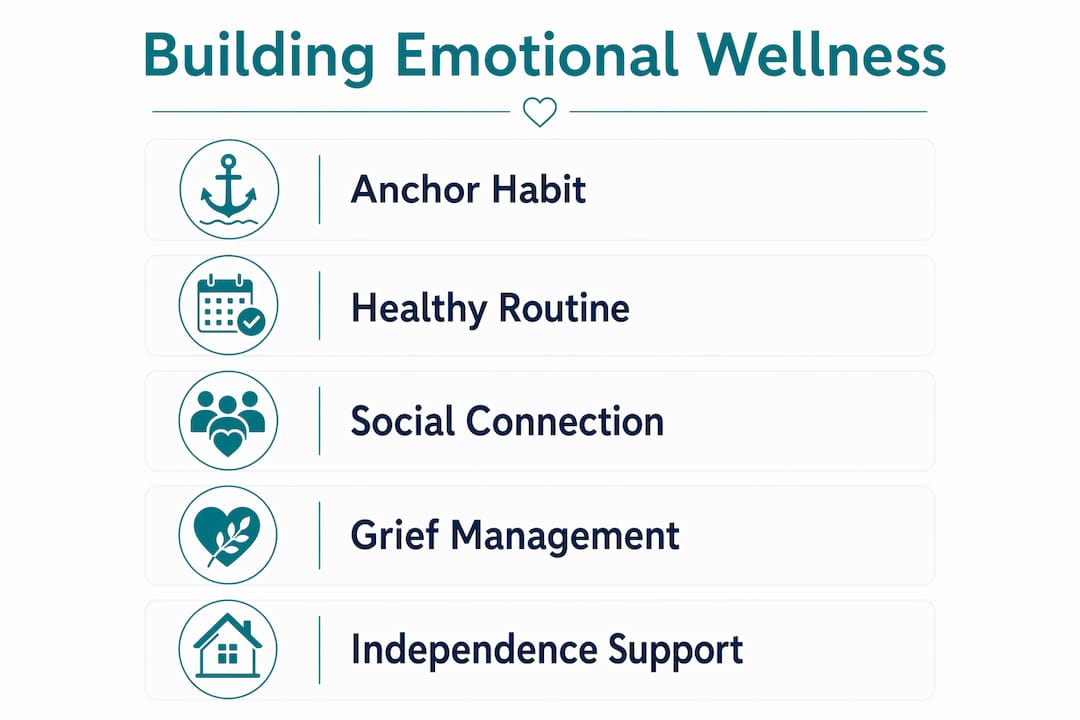
Infographic outlining steps to build emotional wellness for seniors
Structured daily habits are the foundation of emotional stability for older adults. They are not glamorous, but the evidence behind them is solid.
Keep a consistent daily routine.
Structured daily routines provide emotional stability after major life changes like retirement or bereavement. Even simple anchors, such as a set wake time, a morning walk, and a regular meal schedule, give the day shape and reduce anxiety.
Move your body regularly.
Physical activity combined with a healthy diet improves mood, cognitive function, and emotional resilience in seniors. A 20-minute walk three times a week is enough to produce measurable mood benefits.
Prioritize sleep.
Poor sleep amplifies anxiety and reduces the ability to regulate emotion. A consistent bedtime, a dark room, and limiting screens before bed all support better rest.
Practice mindfulness or journaling.
Both techniques slow reactive thinking and create space for reflection. A five-minute morning journal entry, writing three things you noticed or appreciated, costs nothing and builds emotional awareness over time.
Limit stressful media exposure.
Continuous news cycles elevate cortisol and increase anxiety. Setting a defined window for news, such as 30 minutes in the morning, protects your mental state without cutting you off from the world.
Pursue purposeful activities.
Gardening, volunteering, teaching a skill, or joining a book club all provide a sense of contribution. Purpose is one of the strongest predictors of emotional well-being in later life.
Pro Tip:
If building a full routine feels like too much at once, start with one anchor habit. Pick a consistent wake time and protect it for two weeks. That single change often makes the rest of the day easier to organize.
Agingsolo offers a practical guide to healthy routines for seniors that walks through how to build these habits step by step, without overwhelming yourself.
Senior man preparing breakfast in kitchen
Happiness comes and goes. Purpose stays.
One of the biggest themes throughout Aging Solo is that emotional wellness isn't just about feeling good — it's about feeling useful. Waking up with a reason to get out of bed matters just as much as any morning routine.
The research backs this up. Older adults who report a strong sense of purpose have lower rates of depression, better cognitive function, and even longer lifespans. Purpose doesn't need to be grand. It just needs to be real.
Here are ways solo agers build purpose into their daily lives:
Mentoring
Share a skill or life experience with someone younger. Your knowledge is worth passing on.
Volunteering
Food banks, libraries, animal shelters — regular volunteering creates structure and contribution.
Church & community groups
Faith communities and local clubs provide belonging and regular social rhythm.
Grandchildren & family
Being present for younger generations creates meaning that outlasts any single day.
Helping neighbors
Checking in on a neighbor, running an errand, or simply being available builds connection right where you live.
Learning something new
A language, an instrument, a craft — learning keeps the mind engaged and creates momentum.
You don't need to do all of these. One is enough to start. The key is finding something that makes you feel like your presence matters — because it does.
Social connection is not optional for emotional health. It is protective. Social isolation significantly increases the risk of depression, cognitive decline, and mortality in older adults. The quiet that comes with living alone can feel heavier than expected, especially after years of built-in contact through work or family.
The good news is that connection does not require proximity. Brief telephone-delivered counseling by lay counselors reduces loneliness and improves psychological well-being, with effects lasting 12 months. That finding matters because it shows that even low-tech, accessible contact produces real and lasting results.
Practical ways to build and sustain your social circle:
| Connection method | Best for |
|---|---|
| Senior center programs | Regular in-person contact and group activities |
| Telephone befriending | Seniors with mobility limits or rural locations |
| Online community groups | Interest-based connection across distance |
| Intergenerational programs | Purpose, mentorship, and cross-age engagement |
| Volunteer roles | Structured contact with a clear sense of contribution |
Pro Tip:
Interventions that combine structured behavioral activation with mindfulness sustain loneliness reduction better than passive socializing alone. Joining a group is a start. Showing up consistently and engaging intentionally is what makes it stick.
Agingsolo's guide to building your social circle covers specific programs and strategies for solo agers who want to reduce isolation with a real plan.
Grief in later life is not a single event. It accumulates. Each loss, whether a person, a role, a home, or a physical ability, adds weight. Suppressing that weight does not make it lighter.
Validation strategies like memory scrapbooking and remembrance events support healthy grief processing better than emotional suppression. Creating a photo album, writing letters to someone you have lost, or attending a memorial gathering all give grief a legitimate place to exist. That legitimacy is what allows healing to begin.
Practical approaches to grief that actually work:
Grief requires active validation rather than suppression to support emotional healing and the transition into new life stages. That is not a soft sentiment. It is a clinical finding with practical implications for how you spend your time and who you spend it with.
Maintaining choice and control over daily life is one of the strongest protectors of emotional well-being in older adults. When independence erodes without a plan, depression and anxiety often follow. When it is supported intentionally, confidence and purpose grow.
One of the greatest myths about aging solo is believing that independence means doing everything by yourself. It doesn't. True independence comes from knowing when to accept support that helps you continue living life on your own terms.
Assistive devices and home modifications are practical tools, not admissions of defeat. Grab bars, better lighting, a medical alert device, and a reorganized kitchen all reduce fall risk and extend the period during which you can live safely on your own terms. The emotional benefit of staying in your own home is significant and well-documented.
Home care and transportation services extend independence further. A weekly cleaning service, grocery delivery, or a volunteer driver program removes friction from daily life without removing autonomy. These supports work best when arranged proactively, before a crisis forces the decision.
Pro Tip:
Set one achievable goal each month that is purely for enjoyment, not productivity. A new recipe, a short trip, a class at the library. Small goals create forward momentum and signal to yourself that your life is still expanding.
Planning ahead matters
Emotional wellness is much easier to protect before loneliness becomes overwhelming. Building friendships, joining groups, finding meaningful activities, and creating healthy routines today makes tomorrow much easier.
| Support type | Emotional benefit |
|---|---|
| Home modifications | Reduces fear of falls, extends safe independent living |
| Medical alert devices | Builds confidence to move freely at home |
| Home care services | Removes daily friction without reducing autonomy |
| Transportation programs | Maintains access to social activities and appointments |
| Hobby and goal-setting | Creates purpose and forward momentum |
Planning ahead for both health and emotional needs preserves dignity. Agingsolo's guide on aging independently at home walks through the specific supports that make this possible without waiting for a crisis to force the conversation.
Emotional wellness in later life is a skill, not a fixed trait. It is built through consistent habits, real social connection, and proactive planning.
| Point | Details |
|---|---|
| Screen early and often | The IAGG recommends routine depression screening for all adults 60 and over during healthcare visits. |
| Build structured daily habits | Consistent routines provide emotional stability after retirement, loss, or major life change. |
| Prioritize social connection | Telephone counseling and community programs reduce loneliness with effects lasting up to 12 months. |
| Validate grief actively | Memory scrapbooking and remembrance rituals support healing better than suppressing emotion. |
| Plan for independence | Home modifications, assistive devices, and support services protect both autonomy and emotional health. |
The single most common mistake I see is waiting. Waiting for the loneliness to pass on its own. Waiting until depression feels serious enough to mention to a doctor. Waiting until a fall or a health scare forces a conversation about support.
Emotional wellness does not reward patience. It rewards attention. The seniors I have seen thrive are not the ones who had the easiest circumstances. They are the ones who noticed when something felt off and did something about it. They called a friend. They joined a group. They told their doctor the truth.
The normalization of loneliness is the part that troubles me most. When people say "of course I'm lonely, I'm old," they are accepting a condition that is both treatable and preventable. Loneliness is not a personality trait or an inevitable outcome. It is a signal that something needs to change, and change is possible at any age.
Independence and emotional support are not opposites. The most independent people I know are the ones who built the strongest support networks before they needed them. They made the calls, showed up to the groups, and asked for help early enough that asking felt normal. That is the real safety net. Not a device or a service, but a web of real relationships maintained with intention.
If you are aging solo, your emotional health deserves the same planning attention as your finances or your housing. It is not a soft concern. It is the foundation everything else rests on.
You don't have to become someone different to age well on your own. You simply need to keep investing in the parts of life that make you feel connected, useful, curious, and hopeful. Those investments often matter far more than we realize until years later.
— Mike
Small actions, taken consistently, build the foundation for emotional health. Here's a simple plan you can start today.
Call one friend.
Pick up the phone. Even a five-minute conversation can shift your entire day.
Schedule one activity outside your home.
A coffee, a walk, a library visit, a volunteer shift. Put it on the calendar.
Spend 20 minutes walking outside.
Fresh air, movement, and a change of scenery. No goal beyond showing up.
Write down three things you're grateful for.
They don't need to be big. A warm cup of coffee counts. A phone call from a friend counts.
Make one plan for next week.
Something to look forward to. Forward momentum is the best antidote to feeling stuck.
Tell your doctor if you've been feeling persistently sad or anxious.
You don't need to wait until it feels serious enough. If it's been weighing on you, it matters.
Free Download
A simple, honest self-assessment to help you take stock of your emotional well-being and identify areas that might need attention.
No spam. Just a practical tool for your emotional health.
Aging independently does not mean aging without support. It means building the right kind of support before you need it urgently.
Agingsolo offers practical, people-centered guides built specifically for solo agers. Whether you are looking to grow old safely and connected or want a clear starting point for planning your emotional and physical well-being, the resources at Agingsolo are designed for real life, not ideal circumstances. Explore guides on maintaining independence, building healthy routines, emergency planning, and understanding isolation challenges. The guides meet you where you are and help you take the next step with confidence.